Respiratory oscillometry + spirometry
Airway mechanics, measured while the patient breathes normally.
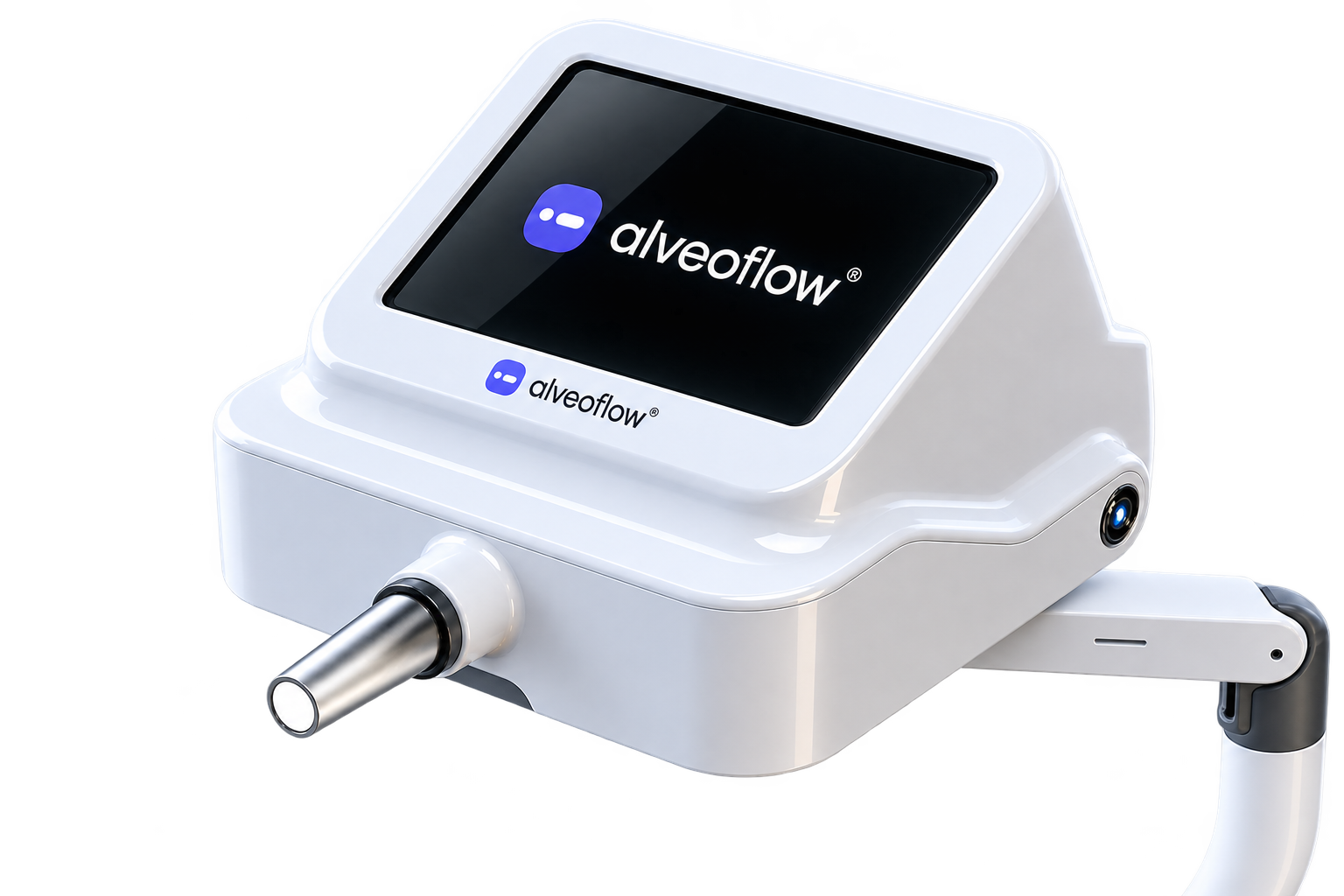
The alveoflow® FOT System applies a low-amplitude oscillatory signal during quiet tidal breathing and resolves airway resistance and reactance across 5–40 Hz. Spirometry runs on the same platform, from the same mouthpiece.
- India
- CDSCO Class B (MDR 2017). Licence no. to be added
- USA
- 510(k) submission pending. Not cleared for sale in the United States.
- Quality
- ISO 13485, MDSAP. IEC 60601-1 series. ISO 10993 biocompatibility.
Why oscillometry
Some patients cannot produce an acceptable forced manoeuvre.
Spirometry depends on maximal effort and a repeatable technique. Oscillometry does not — it measures during the breathing the patient is already doing. That difference decides who you can test, and how often.
Forced manoeuvre required
- Maximal inspiration, then a hard, fast, sustained blow
- Coaching, repeat attempts, acceptability and repeatability criteria
- Difficult in young children, frail or elderly patients, and anyone breathless at rest
- Effort artefact is a common cause of an uninterpretable test
Tidal breathing only
- Patient breathes quietly through the mouthpiece for 15–30 seconds
- No coaching, no maximal effort, no learned technique
- Viable where spirometry is not, including serial testing in the same visit
- Resolves resistance separately at low and high frequency
Oscillometry complements spirometry; it does not replace it. Where both are indicated, the alveoflow® runs the pair in one sitting, which is the reason for putting them on one platform.
What it measures
Six parameters, and what each one tells you.
Select a parameter to locate it on the spectrum.
R5 — total respiratory resistance
Resistance measured at 5 Hz. The low-frequency signal reaches the whole airway tree, so R5 reflects total resistance — central and peripheral together. Raised R5 indicates obstruction somewhere in the system; on its own it does not say where.
Output
What comes back after a test.
Pre- and post-bronchodilator values side by side, with the change expressed against the reference set in use.
- R5
- 0.45 kPa·s·L⁻¹ post 0.34 · −24%
- R5–R20
- 0.12 kPa·s·L⁻¹ post 0.05 · −58%
- X5
- −0.18 kPa·s·L⁻¹ post −0.09 · +50%
- AX
- 1.9 kPa·L⁻¹ post 0.8 · −58%
Specifications
Both modules, in full.
| Method | Forced Oscillation Technique (FOT) / respiratory oscillometry |
|---|---|
| Excitation | Hybrid pseudo-random and chirp waveform |
| Frequency range | 5–40 Hz (optional extension to 60 Hz) |
| Parameters reported | R5, R20, R5–R20, X5, AX, Fres, intra-breath resistance and reactance loops |
| Acquisition time | 15–30 s tidal breathing |
| Repeatability | ±3% resistance, ±5% reactance |
| Accuracy | <2% deviation against reference loads |
| Sampling | 400 Hz acquisition, 24-bit |
| Calibration | Automated pre-test calibration. Verification against supplied reference load |
| Reference equations | To be confirmed |
| Patient range | Adult and paediatric — state minimum validated age |
| Method | Forced spirometry, same mouthpiece and flow head |
|---|---|
| Parameters | FVC, FEV1, FEV1/FVC, PEF, FEF25–75, FEV6 |
| Volume range | 0–8 L |
| Flow range | ±16 L/s |
| Volume accuracy | ±2.5% or ±0.050 L, whichever is greater |
| Flow accuracy | ±5% or ±0.200 L/s, whichever is greater |
| Validation | ATS 24-waveform profile set |
| Reference equations | To be confirmed |
| Display | 10-inch capacitive touchscreen |
|---|---|
| Connectivity | Wi-Fi, Bluetooth 5.3, USB-C, optional Ethernet |
| Software | alveoSenseAI™ analysis and alveoConnect® platform |
| EMR integration | HL7 v2 and FHIR R4 |
| Security | AES-256 in transit and at rest. Data regime to be stated |
| Operating environment | 10–45 °C, 10–90% RH non-condensing |
| Noise level | <20 dBA |
| Dimensions / weight | To be added |
| Power / battery | To be added |
| Consumables | Mouthpiece, bacterial/viral filter — specify type and dead space |
| Warranty / service | To be added |
| Radio | FCC ID 2AV9TD8-52832-01 |
Clinical applications
Where it is used.
Settings
Assessments
Standards and evidence
What the system is built and tested against.
Technical standards
- Oscillometry: ERS technical standard on respiratory oscillometry — King GG et al., Eur Respir J 2020;55:1900753
- Spirometry: ATS/ERS standardisation of spirometry, 2019 update — Graham BL et al., Am J Respir Crit Care Med 2019;200:e70–e88
- Electrical safety: IEC 60601-1 series
- Biocompatibility: ISO 10993 series
- Quality system: ISO 13485, MDSAP
Validation
A paired method-comparison study against a reference oscillometry system is in progress. Bland–Altman agreement and repeatability data are available to clinicians and evaluators on request.
Questions
Frequently asked.
What is respiratory oscillometry?
A small pressure oscillation is applied at the mouth while the patient breathes normally. Measuring the resulting pressure and flow gives respiratory impedance, which separates into resistance and reactance at each frequency tested.
Does it replace spirometry?
No. The two measure different things — spirometry measures volumes and flows during a forced manoeuvre; oscillometry measures the mechanical properties of the airways during tidal breathing. They are complementary.
What do R5–R20 and AX tell me?
R5–R20 is the difference between low- and high-frequency resistance. A widened gap points to peripheral rather than central obstruction. AX is the area bounded by the reactance curve below zero up to the resonant frequency.
What is the minimum age for testing?
To be confirmed — state the minimum age this device is validated for, rather than “paediatric”.
How long does a full assessment take?
To be confirmed — give the timing for oscillometry alone, and for a pre/post bronchodilator pair.
What are the infection control requirements?
To be confirmed — name the filter, state whether the mouthpiece is single-use, and list validated cleaning agents.
How do results reach our EMR?
Results are exported over HL7 v2 or FHIR R4 via the alveoConnect® platform, or as PDF to a shared location. A sandbox is available for integration testing before purchase.
Is it available in the United States?
Not currently. A 510(k) submission is pending and the device is not cleared for sale in the United States. It is available in India under CDSCO Class B, and in other markets on a country-by-country basis.
See it run on a real patient list.
A 30-minute session on your own cases, with a clinician who uses the system. Or ask for pricing and lead times for your market.