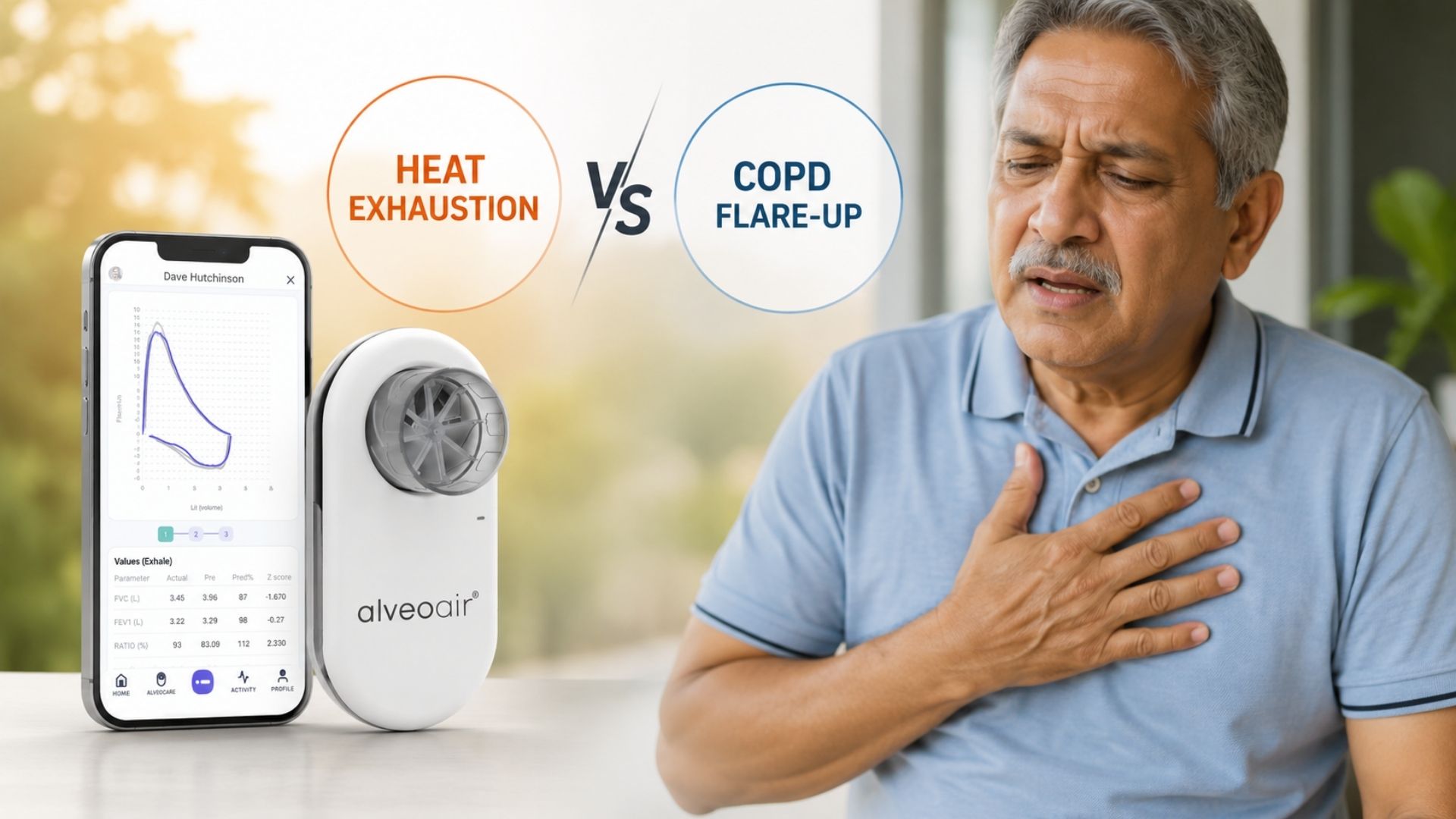
Does your breathing feel worse after spending time in the summer heat? Or are you wondering whether your fatigue and breathlessness could signal a COPD flare-up instead of simple heat exhaustion?
Distinguishing between the two is often more difficult than many people realize because both conditions share several overlapping symptoms. Understanding the differences however can help you respond more appropriately and seek timely medical care when needed.
In this article, we explain how to recognize the warning signs. We also talk about why symptoms alone can sometimes be misleading. Additionally we dwell into how objective lung monitoring via portable digital spirometer can support better respiratory awareness during extreme summer conditions.
Why Summer Heat Is More Than Just a Seasonal Discomfort for COPD Patients
Many people living with COPD prepare themselves for winter infections or poor air quality. However, very few people in India consider extreme summer heat to be an equally crucial respiratory trigger.
In fact, emerging scientific evidence suggests that prolonged exposure to high temperatures can significantly worsen respiratory outcomes in people with chronic lung diseases.
Researchers around the world are now finding that heatwaves do far more than cause temporary discomfort. They can increase the risk of COPD flare-ups, emergency hospital visits, and even death. Understanding how heat affects the lungs can help patients recognize risks early and take timely action.
Extreme Heat Is a Proven Risk Factor for COPD Complications
The relationship between extreme heat in India and COPD is now supported by a growing body of scientific evidence. A systematic review and meta-analysis published in 2025 evaluated 25 observational studies conducted between 2000 and 2024. Researchers analyzed how extreme temperatures affected COPD-related illness and death across different populations.
The review found that extreme heat increased COPD morbidity by approximately 16% and mortality by nearly 19%. Older adults and people with chronic respiratory diseases were identified among the most vulnerable groups. These findings reinforce an important message.
Summer heat should not be viewed as a seasonal inconvenience for COPD patients. It is an environmental trigger that deserves the same level of attention as respiratory infections or air pollution.
Even a Small Rise in Temperature Can Increase Hospitalization Risk
Heat does not need to reach record-breaking levels to affect respiratory health.
A population-based study published in Thorax analyzed 12 years of COPD hospital admissions across England. Researchers observed that for every 1°C increase in summer temperatures above 23.2°C, the risk of COPD hospitalization increased by approximately 1.47%.
The study also estimated that a measurable proportion of summer COPD admissions could be directly attributed to heat exposure.
Many patients already know that viral infections, cigarette smoke, and polluted air can trigger flare-ups. However, prolonged exposure to high temperatures is often overlooked. This research highlights that heat itself can quietly contribute to respiratory deterioration.
Why High Temperatures Make Breathing More Difficult
Extreme heat places additional demands on the body, many of which directly affect breathing. Several physiological changes occur simultaneously, increasing the burden on already compromised lungs. Heat exposure may:
- Increase breathing rate as the body attempts to regulate its internal temperature.
- Cause dehydration, which can thicken airway mucus and make it more difficult to clear.
- Reduce mucociliary clearance, allowing secretions to accumulate inside the airways.
- Increase cardiovascular workload, forcing the heart and lungs to work harder together.
- Interact with elevated ozone and PM2.5 pollution levels, further irritating inflamed airways.
These changes can make breathing feel noticeably more difficult, even in the absence of an infection. As a result, many COPD patients may experience worsening breathlessness during heatwaves without immediately recognizing that the weather itself is contributing to their symptoms.
Hotter Summers Are Making COPD Management More Challenging
Climate researchers continue to report that heatwaves are becoming more frequent, longer-lasting, and more intense across many parts of the world. This trend is expected to increase the health burden associated with chronic respiratory diseases.
Recent reviews examining climate change and COPD warn that rising temperatures are likely to increase respiratory morbidity and mortality in vulnerable populations. Older adults and individuals living with chronic lung diseases remain particularly susceptible to these environmental changes.
As Indian summers continue to become more extreme, proactive respiratory monitoring via devices like portable digital spirometers is becoming increasingly important. Recognizing breathing changes early may help patients seek medical attention before a mild decline progresses into a serious COPD flare-up.
How Do You Know the Difference Between Heat Exhaustion And A COPD Flare-Up?
One of the biggest challenges during summer is that heat exhaustion and a COPD flare-up often present with remarkably similar symptoms. Both conditions can leave you feeling physically drained and make breathing more difficult than usual. As a result, many people struggle to understand whether their symptoms are caused by prolonged heat exposure or worsening lung function.
This confusion is understandable because both conditions affect the body's ability to function efficiently under stress. However, identifying certain warning signs may help you better understand what your body is trying to communicate.
Symptoms Commonly Seen in Both Conditions
Heat exhaustion and COPD flare-ups share several overlapping symptoms, including:
- Breathlessness
- Fatigue
- Weakness
- Dizziness
- Reduced exercise tolerance
- Faster breathing
These similarities often make it difficult to distinguish one condition from the other, especially during serious heatwaves.
Signs That May Point Toward Heat Exhaustion
Heat exhaustion develops when the body struggles to regulate its temperature after prolonged exposure to high environmental heat. Symptoms of heat exhaustion often improve after moving to a cooler place and restoring lost fluids. Common signs of heat exhaustion include:
- Heavy sweating
- Cool or clammy skin
- Intense thirst
- Muscle cramps
- Headache
- Nausea or light-headedness
- Symptoms that improve after cooling down and hydration
Signs That May Suggest a COPD Flare-Up
A COPD flare-up occurs when airflow limitation suddenly worsens due to airway inflammation or other respiratory triggers. Unlike heat exhaustion, breathing difficulties often persist and may gradually become more severe without appropriate medical attention. Signs that may indicate a COPD flare-up include:
- Worsening cough
- Increased mucus production
- Change in sputum colour or consistency
- Wheezing
- Chest tightness
- Persistent breathlessness despite cooling and hydration
- Ongoing reduction in daily activity tolerance
Although these differences can provide useful clues, they do not always offer a definitive answer. Many symptoms overlap, and individual experiences can vary significantly from person to person. This is why relying solely on how you feel during a heatwave may sometimes be misleading, particularly for people living with chronic respiratory diseases such as COPD.
Why Guessing Based on Symptoms Alone Can Be Risky
People living with COPD often adapt to gradual breathing difficulties over time. As a result, many COPD patients begin accepting breathlessness or reduced stamina as part of their normal routine. But this can make it even harder to recognize when lung function is actually worsening, especially during extreme summer heat.
Heat exhaustion adds another layer of confusion by causing symptoms such as fatigue, dizziness, and shortness of breath that closely resemble a COPD flare-up. Relying solely on how you feel may therefore lead to delayed action or unnecessary panic.
This is where comparing symptoms with objective readings from a portable digital spirometer proves beneficial. This is exactly why healthcare professionals also encourage objective respiratory monitoring for COPD patients alongside symptom awareness. Comparing your current lung function with your usual baseline through a portable digital spirometer can provide valuable insight to doctors. It can help them identify meaningful changes that symptoms alone may not reveal.
How a Portable Digital Spirometer Can Help You Understand Sudden Breathing Changes?
Heat exhaustion and COPD flare-ups can produce remarkably similar symptoms. Breathlessness, fatigue, and weakness may occur in both conditions, making it difficult to understand what your body is experiencing. While symptoms should never be ignored, objective lung function data can provide additional clarity during such situations.
A portable digital spirometer supports proactive respiratory monitoring in several ways:
- Helps compare your breathing with your personal baseline: Regular use helps establish your normal lung function. It makes it easier to identify meaningful declines during periods of extreme heat.
- Provides objective information beyond symptoms: Feelings of breathlessness can vary from day to day. A portable digital spirometer provides measurable lung function data rather than relying solely on personal perception.
- Supports early recognition of respiratory decline: If lung function remains reduced despite cooling down and staying hydrated, it may indicate worsening respiratory status that deserves prompt medical attention.
- Tracks long-term breathing trends: Monitoring over weeks and months helps identify gradual changes that isolated readings or memory alone may fail to capture.
- Facilitates better discussions with healthcare providers: Stored reports and lung function trends can be shared with your physician. It can help them better understand changes in your respiratory health and make more informed treatment decisions.
Note that a portable digital spirometer does not diagnose heat exhaustion or a COPD flare-up on its own. However, it provides valuable objective information that complements symptom awareness and supports more proactive respiratory management, especially during periods of extreme summer heat.
Conclusion
Heat exhaustion and COPD flare-ups can appear very similar, making it difficult to understand what your body is experiencing during extreme summer conditions. Recognizing whether you are experiencing heat exhaustion or COPD flare-up is important. However, you cannot rely solely on symptoms to find the cause as it may not always provide a complete picture. This is where objective lung function monitoring proves crucial. It can offer additional clarity and help identify meaningful changes before they become more serious.
Our mission at alveofit is to make respiratory monitoring more accessible, proactive, and reliable for people across India. Our innovative solutions like alveoair empower individuals to track their lung function with confidence and stay better informed about their respiratory health. So,why not combine symptom awareness with regular monitoring?
Choose our portable digital spirometer so you can take more proactive steps toward protecting your lungs and managing COPD more effectively throughout the summer.